
Article
Specifying a Pallet Shuttle System: Key Tips
By David Scelfo, Director of Marketing
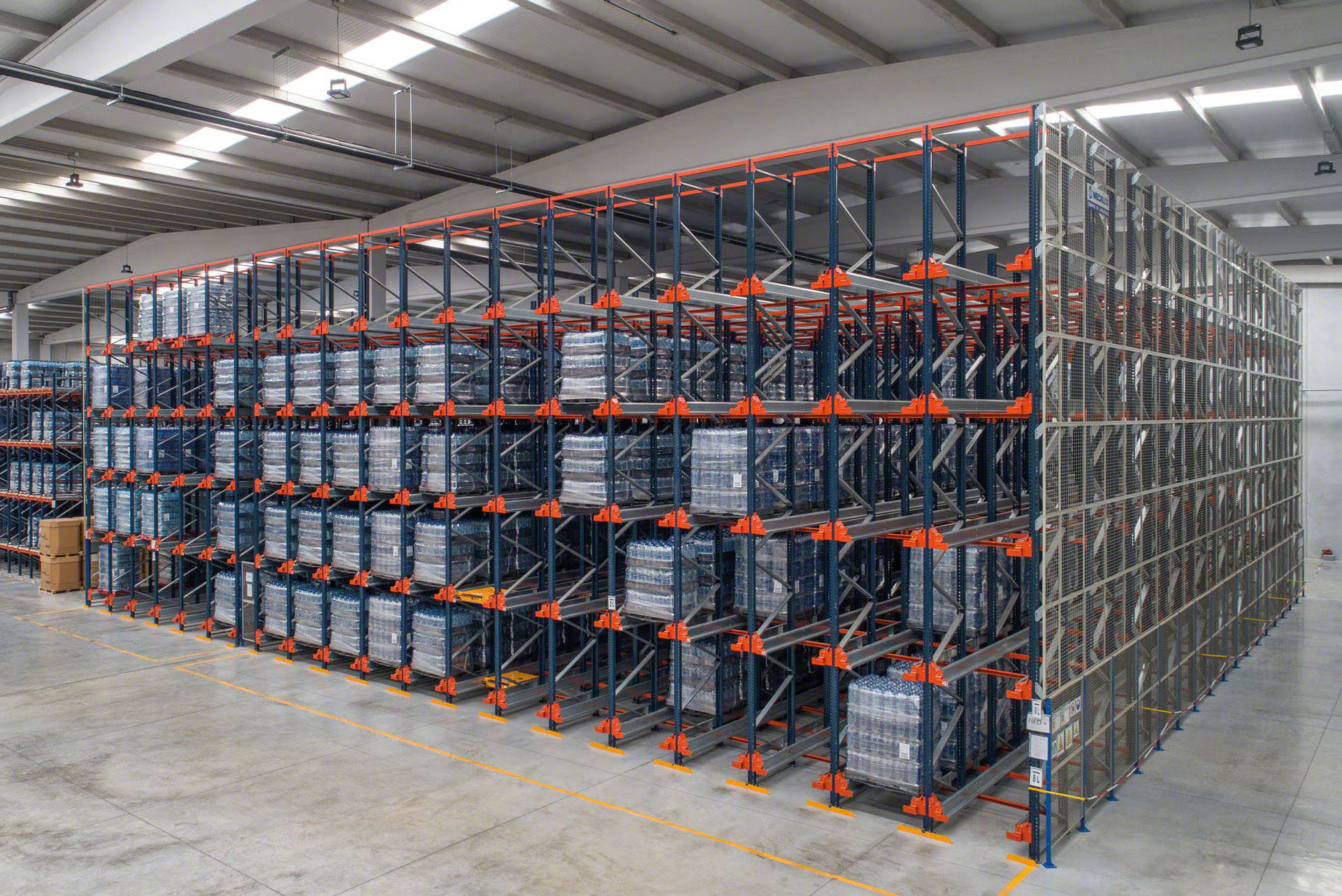
A pallet shuttle system looks straightforward on paper: motorized shuttle, deep storage channels, Wi-Fi tablet control. The specs are compelling. Channels over 130 feet deep, 3,300 lb capacity, FIFO or LIFO switchable on the fly.
But the specs only tell you what the shuttle can do. They do not tell you whether it will work well in your facility. That depends on your pallets, your floor, your building height, your product mix, and a handful of planning decisions that are easy to overlook. This guide covers the practical details that determine whether a shuttle system delivers on its promise or creates operational headaches.
Pallet Quality Is Not Optional
The shuttle lifts pallets by their stringers, moves them horizontally at up to 300 feet per minute, and deposits them with precision. That process assumes the pallets can handle it.

Maximum pallet deflection is under one inch. If a loaded pallet sags more than an inch, the shuttle will contact the pallet during horizontal travel. That means a jam, an operational stop, and an alert to the operator's tablet. Heavy loads on weak pallets are a non-starter.
Stringer thickness matters. The shuttle makes contact with the pallet through its stringers. If the stringers are too thin, the pallet can bend or break under the shuttle's lifting force. Standard GMA pallets with full-width stringers work well. Pallets with narrow or damaged stringers do not.
Damaged pallets cause problems. This is similar to what you would see with push-back or pallet flow racking: small chips are manageable, but pallets that are breaking apart will cause jams and operational stops. In a shuttle system, a broken pallet 25 positions deep in a channel is a much bigger problem than one at the front of a push-back lane.
Plastic wrap cannot hang below the pallet. The shuttle travels underneath the pallet. Any loose wrapping, stretch film, or bag material that extends below the stringer line can catch on the shuttle and trigger a stop. Loads need to be wrapped cleanly above the pallet deck.
Colored plastic pallets may need special sensors. The shuttle uses optical sensors to detect pallet positions. Standard sensors work with most pallet colors, but certain colors (red, for example) can absorb the sensor signal instead of reflecting it. If your operation uses colored plastic pallets, that needs to be flagged during the design phase so the correct sensors are specified.
Mixed Pallet Depths Will Slow You Down
The shuttle's published throughput numbers assume all pallets in a channel are the same depth. When pallets vary in depth (for example, a mix of 44-inch, 46-inch, and 48-inch pallets in the same system), the shuttle has to reposition itself for each pallet. It lowers, adjusts position, lifts again, and then moves. This repositioning cycle adds time to every load and unload operation.
The productivity difference is significant. On a standard channel with uniform pallet depths, the shuttle runs at its full rated speed. With mixed depths, throughput can drop noticeably because every pallet requires an extra positioning step.
Width variation is fine. The shuttle can handle pallets of different widths without any throughput penalty. It is only depth variation that triggers repositioning.
If your operation handles pallets of multiple depths, the system will still work. It will just be slower than the spec sheet suggests. That needs to be factored into your throughput planning.
There Is a Depth Sweet Spot
Shuttle systems can go deep. Channels over 130 feet, 40+ pallets deep, are technically possible. But productivity plateaus around 32 pallets deep. Beyond that point, the shuttle is spending so much time traveling that adding more depth does not meaningfully increase storage throughput. The forklift operator ends up waiting on the shuttle instead of the other way around.
The ideal design keeps lane depth at or under 32 pallets. That gives you the density advantage without sacrificing the throughput that makes the system worth the investment. If your layout requires more depth, the system will function, but throughput per channel levels off.
The other factor at extreme depths is Wi-Fi signal range. The shuttle's onboard router has a typical range of about 250 feet. Beyond 32 pallets deep, the shuttle may temporarily lose its Wi-Fi connection. It will finish its current command and reconnect when it returns to range, but continuous two-way communication with the tablet is not guaranteed at extreme depths.
Your Floor Slab Has to Be Right
This is one that gets overlooked. A shuttle system rides on rails mounted to the rack structure, and the rack structure is anchored to the floor. If the floor slab has excessive variation, low spots, cracks, or insufficient load-bearing capacity, the rails will not sit level and the shuttle will not track properly.
This is not unique to shuttle systems. Drive-in racking and pallet flow systems have the same sensitivity. But with a shuttle, a floor problem 100 feet into a channel is much harder to address after installation than a floor problem at the aisle face.
Floor flatness and levelness should be evaluated during the design phase. If the slab has issues, they need to be addressed before the rack goes in, not after.
Cold Storage Changes the Equation
The shuttle is rated from -22 degrees F to 113 degrees F, which covers everything from deep freeze to ambient warehouses. For cold storage and food and beverage operations, the shuttle is not just "the same unit in a colder room." There are real differences.
Different shuttle model. Cold storage shuttles have insulated electronic components to protect against condensation and temperature extremes. This is a different unit than the ambient-temperature shuttle.
Shorter battery life. Lithium batteries in ambient conditions provide 8 to 10 hours of continuous operation. In cold storage environments, that drops to 6 to 8 hours. Multi-shift operations in cold storage should plan for extra batteries and a charging rotation.
The operational advantage is real. In freezer environments, operators want to spend as little time inside the chamber as possible. The shuttle changes the workflow fundamentally. Instead of driving a forklift deep into a lane, the operator places pallets at the channel entrance and leaves. The shuttle handles all in-lane movement from there. This reduces operator cold exposure dramatically and keeps freezer doors closed longer.
Charging stations for cold storage environments also differ. They include cable connections that allow the shuttle to charge without removing the battery, which simplifies end-of-shift procedures in environments where handling small components with gloves is difficult.
Safety Features Beyond the Basics
Every shuttle comes with standard safety features: front and rear bumpers that trigger an immediate stop on contact, an emergency stop button, and real-time status feedback to the operator's tablet. But there are several optional features that become important depending on your installation.
Safety scanner. Instead of relying on physical contact to stop the shuttle, a safety scanner sends out a detection signal and stops the shuttle when anything enters a programmable range (typically around three feet). This prevents the shuttle from ever making contact with an obstruction or a person.
Positioning camera. For installations where the shuttle operates above 20 feet, a positioning camera gives the operator a live view from the shuttle's perspective (front and rear). Think of it as a backup camera for the forklift operator, helping them place the shuttle accurately on the rails at height.
Tilt meter. If the forklift operator loads the shuttle at an angle instead of level with the rail, the tilt meter triggers an alert on the tablet. This prevents the shuttle from entering a channel misaligned, which could cause a jam or rail damage.
Magnetic fork attachment. Magnets on the bottom of the shuttle lock it to the forklift forks during transport between channels. The operator activates and deactivates the magnets via the tablet.
Safety fencing and netting. On sides of the system that are open to pedestrian traffic, safety fencing prevents anyone from walking into an active channel. For installations with tunnel bays (walkways through the rack structure), safety netting catches anything that might fall from upper levels.
Where these accessories are needed depends on your facility layout. That is why a detailed site drawing is part of every shuttle system design.
The Low-Profile Option
Standard shuttle installations position the top of the first pallet at about 18 inches above the floor. For buildings with limited clear height or in-rack sprinkler concerns, a low-profile foot plate and a modified beam position can bring that down to 12 inches. That six-inch gain on the bottom level can sometimes mean fitting an additional storage level at the top of the system.
Load Overhang Is Less of a Problem
One advantage the shuttle has over gravity-based systems like push-back and pallet flow is load overhang tolerance. The shuttle can accommodate up to 16 inches of total overhang: 8 inches in the front and 8 inches in the back.
For operations that handle loads wider than the pallet (common in manufacturing and distribution), this flexibility means fewer rejected pallets and less re-palletizing before storage.
Fire Code Compliance Is Built In
Municipal fire codes increasingly require continuous transverse flue spaces in deep storage systems, typically every five pallets. With manual systems, maintaining those flues depends on operator discipline. With the shuttle, flue spacing can be programmed directly into the system. The shuttle automatically leaves the required gap at the correct intervals.
The shuttle can also be programmed to maintain specific distances between individual pallets, which is useful for facilities with strict fire code requirements around water flow through the rack structure.
This is one area where the shuttle's automation directly supports permitting and compliance. The flue spaces are enforced by the system, not by training and hope.
What a Turnkey Project Looks Like
A shuttle system project involves three main components: the racking structure, the shuttles, and the control software. The racking is manufactured domestically. The shuttles and rail systems are manufactured in Europe and shipped to the project site.
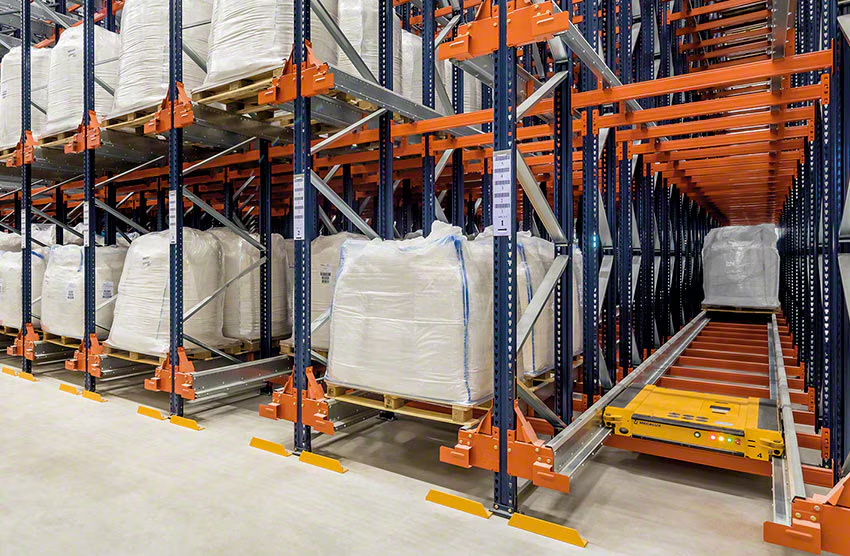
Installation is handled by experienced racking installers, with a project manager on site to oversee the shuttle integration. After installation, the manufacturer's team stays on site for one to two weeks to commission the system and train your operators. The training covers tablet operation, battery management, shuttle positioning, towing procedures, and troubleshooting.
Post-installation support options range from a phone support line to scheduled annual maintenance visits, depending on the service tier. Extended warranties and maintenance contracts are available to protect the system beyond the standard one-year warranty.
Is It the Right Fit?
The pallet shuttle fills a specific gap in the storage spectrum. It goes deeper than push-back (which tops out at 6 deep), eliminates the forklift-in-the-lane risk of drive-in, and costs less than a fully automated AS/RS. To see how the shuttle compares to crane-based and goods-to-person automation, see our guide to the types of automated storage and retrieval systems. It is not the right answer for every high-density application, but when the conditions line up (high volume per SKU, deep channels, consistent pallet quality, a good floor slab), it delivers density and throughput that manual systems cannot match.
The planning details in this guide are the things that separate a shuttle system that performs as expected from one that does not. Getting them right starts in the design phase. You can also compare shuttle capacity against other systems in your warehouse dimensions using our free capacity calculator.