
Article
How to Choose Rack Protection: Where Guards and Barriers Go
By David Scelfo, Director of Marketing
Most rack damage comes from forklifts. A loaded forklift moving through an aisle hits a column, and now you've got a bent upright holding up 15,000 pounds of product. Sometimes the damage is obvious. Sometimes it's a subtle bow that gets worse with every load cycle until the column buckles.
The fix isn't complicated. A few hundred dollars in rack protection on the right columns can prevent a five-figure repair or, in a worst case, a collapse. The hard part is knowing which type of protection goes where and not overspending on protection you don't need.
This guide is about placement: how to find the positions that actually take damage, which type of protection belongs at each one, and how to prioritize when you can't protect everything at once.
If you already know what you need and want product detail, specifications, and pricing instead, go straight to rack protection for guards that mount to the rack frame, or guardrails and safety barriers for floor-anchored protection. For the other accessories that complete a rack system, from wire decking to row spacers and load signage, see our pallet rack accessories guide or our pallet rack components and parts page for how we spec and supply them.
Why Rack Protection Matters
Forklift impact is the number one cause of pallet rack damage. A typical sit-down counterbalance forklift weighs 9,000 to 12,000 pounds, and operators make thousands of turns per shift. Even low-speed contact with an unprotected column can cause enough deformation to reduce its load capacity, and a hard enough hit can compromise the anchor connection at the base.
The expensive part isn't the column itself. It's everything around it. You often can't just replace the damaged column. You have to unload the bay, unload adjacent bays in some cases, disassemble the section, install a new upright, reload everything, and document the repair. A single damaged upright can cost $2,000 to $5,000 to replace when you factor in labor, downtime, and the engineered replacement component.
Column guards cost $30 to $80 each. End-of-aisle protectors run $150 to $400. The math is straightforward.
Beyond cost, there's a compliance angle. If a rack system is damaged and the damage isn't documented and assessed, you're operating outside the requirements of ANSI MH16.1 (the national rack design standard) and potentially outside your facility's permit conditions.
Column Guards
Column guards are the most common form of rack protection. They wrap around or bolt to the base of individual upright columns to absorb forklift impact before it reaches the structural steel.
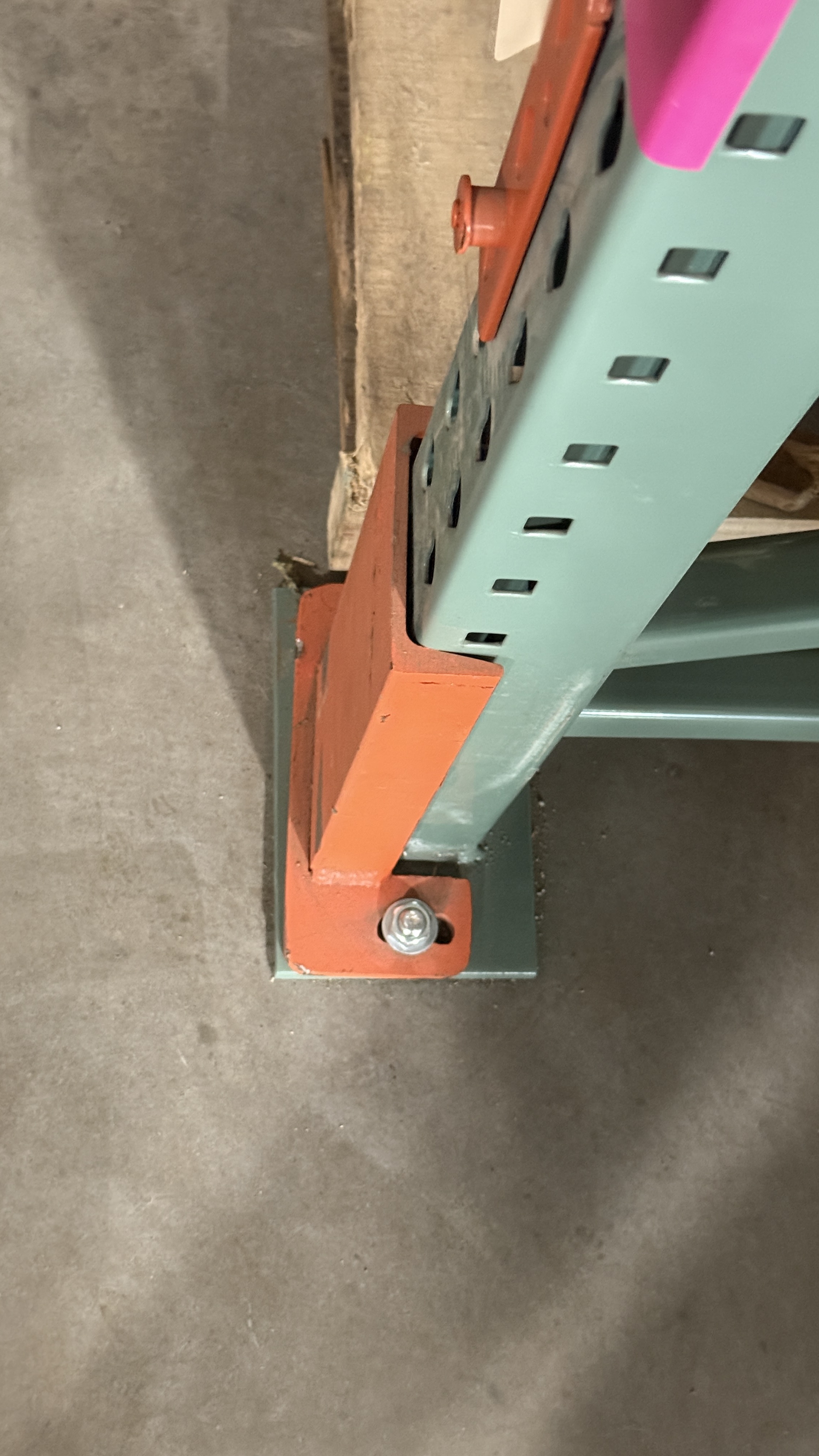
The two common styles are wrap-around post protectors, which clip or bolt around the column at floor level, and lower-profile bolt-on base protectors that work better in tight aisles. Polymer absorbs and deflects, steel handles heavier impact but transfers more force into whatever it's mounted to. Full specifications, materials, and cost ranges are on the rack protection page.
The decision that matters more than the style is where they go.
Where to install column guards
You don't need them on every column. Focus on the positions that take the most abuse:
- Aisle-facing columns on the first and last bays of each row (where forklifts turn into and out of aisles)
- Cross-aisle columns at intersections where forklifts travel perpendicular to the racking
- Columns near dock doors and staging areas where traffic is heaviest and operators are maneuvering with loaded forks
- Any column with existing damage history, even after repair
When you're budgeting a new rack installation, plan for column guards on at least the first and last uprights of every row. On high-density systems like drive-in racking, where forklifts enter the rack structure itself, column protection on the entry lanes is especially important.
Sizing notes
Column guards have to match your upright profile, since teardrop, structural channel, and open-back columns all have different dimensions, and the guard has to clear the base plate and anchor bolts. Guards also add roughly four to six inches per side to the rack footprint, so check that against your aisle clearance before committing to a style.
End-of-Aisle Protectors
End-of-aisle guards protect the exposed ends of rack rows, which are the most vulnerable points in any racking system. This is where forklifts make 90-degree turns into aisles, and the end frame takes the hit if the operator cuts the turn short.
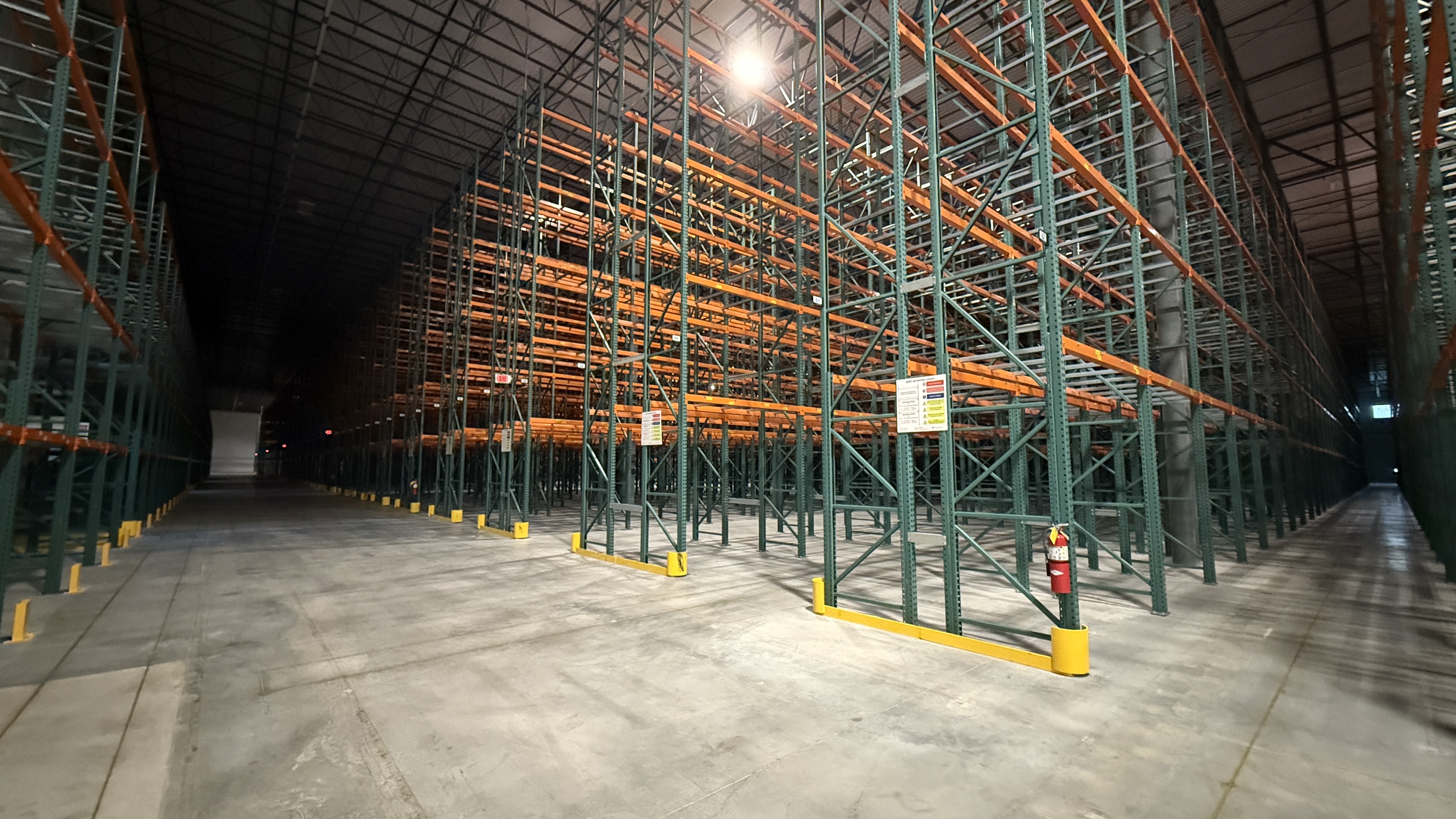
An impact at the end of a row is different from a mid-aisle hit. It affects the entire row, not just one bay. The end frame is a structural anchor point. Damage there can compromise the alignment and stability of every bay connected to it. Mid-aisle damage is usually isolated to one or two bays. End-of-aisle damage can cascade.
There are two approaches. Floor-anchored steel guards sit in front of the rack end and keep force away from the structure entirely, but need concrete anchoring. Wrap-around end guards attach to the end upright and protect the beam-to-column connection at the same time, and install without separate floor anchoring. Specifications and cost for both are on the rack protection page.
Placement
End-of-aisle protectors go on every exposed rack end that faces a travel aisle. If a forklift drives past it, it needs protection. In a typical warehouse layout, that means:
- Both ends of every single-entry aisle
- The exposed end of back-to-back rows that face cross aisles
- Any row end near a dock door, shipping lane, or staging area
Plan for end-of-aisle protection on both sides of every row. Skipping the "less busy" side is a gamble that usually catches up with you.
Bollards
Bollards are freestanding steel posts anchored into the concrete floor. They don't attach to the racking at all. Instead, they create a physical barrier between forklift traffic and whatever you're trying to protect.
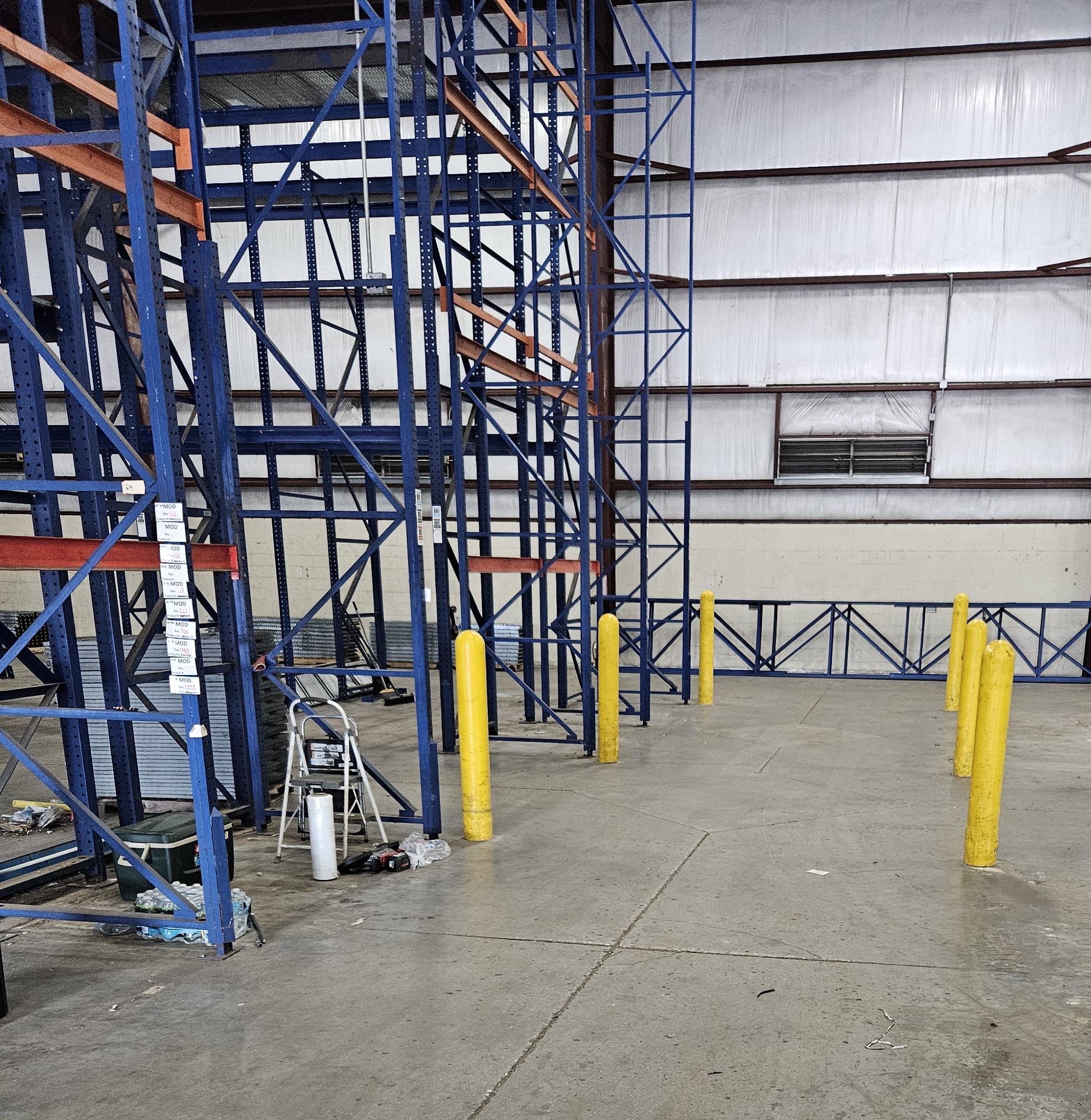
Bollards make sense when you need to protect something that isn't a rack column, or when you want standoff distance between the barrier and the structure. Common applications:
- Building columns (structural steel or concrete columns that support the roof)
- Fire suppression risers and electrical panels
- Pedestrian walkway entrances alongside racking
- High-value equipment positioned near forklift traffic
- Rack row ends where you want a buffer zone between the travel lane and the rack, rather than a guard mounted directly to the frame
Bollards anchor into the slab, either core-drilled with epoxy anchors or base-plated with expansion anchors, which makes slab thickness and condition a real constraint. Post-tensioned slabs are the bigger problem, because drilling can strike a tendon. Sizes, ratings, and anchoring detail are covered on the guardrails and safety barriers page.
Spacing and placement
Bollards need to be spaced close enough that a forklift can't slip between them. A typical spacing is 3 to 4 feet on center. Place them far enough from the protected object (usually 6 to 12 inches of clearance) that the bollard can deflect under impact without pushing into the thing it's protecting.
Guardrails
Guardrails are continuous steel rail systems anchored to the floor. Think of them as a connected series of bollards with a horizontal rail running between them. They protect longer runs and create defined traffic lanes.
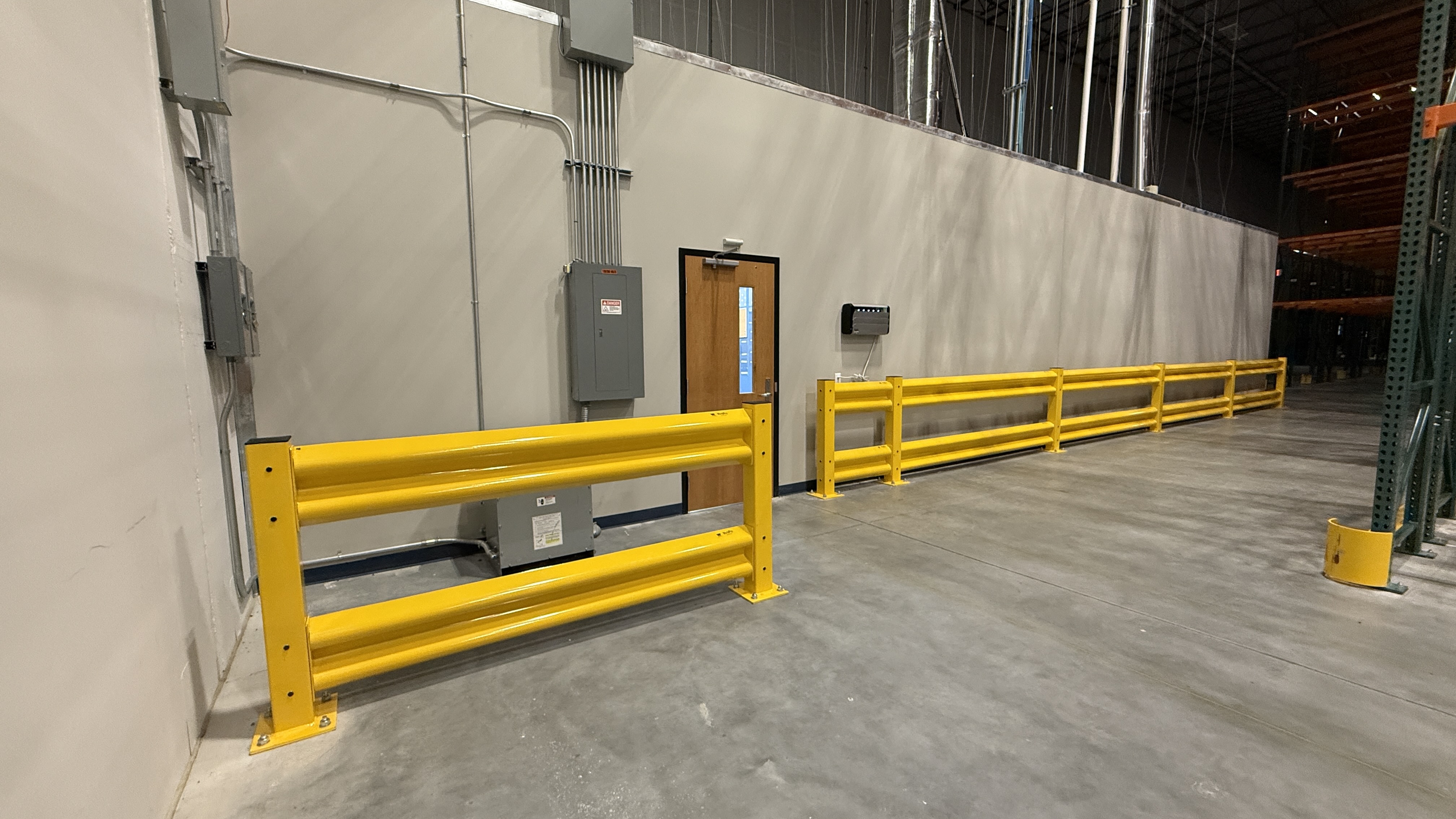
Guardrails make more sense than individual bollards when you're protecting a longer run:
- Long exposed row ends where you'd otherwise need a bollard every 3 feet
- Pedestrian separation along rack aisles where people and forklifts share space
- Mezzanine perimeters and elevated platforms adjacent to racking
- Dock areas where trailer traffic and rack systems are close together
Single-rail systems define a boundary and handle lower-speed contact. Double-rail adds a second height that catches the truck's upper body and counterweight rather than just the base, which is what you want wherever people are on the other side of it. Lift-out sections give you access points without leaving a permanent gap.
One caution on impact ratings: manufacturers publish them as a weight at a speed, but the test conditions and assumed anchor detail differ between makers, so the headline number alone isn't a specification. Rail heights, post spacing, and anchoring requirements are covered on the guardrails and safety barriers page.
How to Decide What Your Facility Needs
You don't need all four types everywhere. A few questions will narrow it down quickly:
Start with the damage you already have. Walk your facility and look at where columns are bent, scraped, or previously repaired. Those locations tell you exactly where protection is needed. If you're seeing repeat damage on the same columns, that's a layout or traffic pattern issue that guards alone won't fix, but they'll buy you time while you address the root cause.
Protect the high-consequence positions first. End-of-aisle guards and column guards on the first and last uprights of each row are the minimum. These positions take the most hits and have the highest consequence when they fail.
Use bollards and guardrails for non-rack assets. Building columns, fire risers, electrical panels, and pedestrian areas need protection too, and rack-mounted guards won't work for those.
Factor in your forklift fleet. Heavier forklifts need heavier protection. A 3,000 lb walkie stacker moving at 3 mph is a different threat than a 12,000 lb sit-down forklift moving at 8 mph. Match the protection to the equipment.
Budget rack protection into the original installation. It's cheaper to install guards during the initial rack build than to come back and retrofit. On most projects, rack protection accessories add 5% to 10% to the material cost. That's a fraction of what a single damaged upright replacement costs.
If you already have damage, protect second and assess first. Guards prevent future impact but do nothing for a column that's already bent, and a deformed upright doesn't recover its rated capacity on its own. Get the current condition documented through a safety inspection and corrected through repair and maintenance, then protect what you've fixed.
Once you know which positions need protection, the product detail lives on the two pages this guide feeds: rack protection for column protectors and end-of-aisle guards, and guardrails and safety barriers for floor-anchored protection of people, structure, and equipment.
We include protection recommendations as part of our design and layout process. If you're planning a new installation or need to assess an existing system, reach out for a quote.