
Article
Wire Decking for Pallet Rack: A Spec Guide
By David Scelfo, Director of Marketing

Wire decking is the accessory most people treat as a commodity. It gets ordered by the pallet-load at the end of a rack project, usually by size alone, and nobody thinks about it again until a deck buckles under a load it was never rated for or a fire marshal asks why there's plywood in the bays.
It deserves more attention than that. The deck is the surface your product actually sits on, it carries its own capacity rating that has nothing to do with your beams, and in most sprinklered buildings it isn't optional. This guide covers how to specify it.
What Wire Decking Actually Does
A pallet rack bay without decking is two beams and open air. That works if every pallet is in good condition, sized correctly, and set squarely on both beams. In a real warehouse none of those hold for long.
Decking solves four problems at once:
It catches pallets that don't behave. Broken stringers, undersized pallets, slip sheets, and loads that overhang their footprint all have a way of finding the gap between beams. A deck turns a two-point support into a full surface.
It carries non-palletized product. Cases, cartons, totes, drums, and hand-stacked goods need something under them. Decking is what makes a rack bay usable for anything that isn't a full pallet.
It lets the building's fire protection work. Water, light, and air pass through mesh. This is the part people underestimate, and it gets its own section below.
It survives forklift contact better than wood. A board splinters and a deck bends. Neither is good, but only one of them drops a load.
Deck Styles: Three Independent Choices, Not One List
Most decking guides, including an earlier version of ours, present deck styles as a single list: waterfall, flush, flared channel, inverted channel. That's misleading, because those four names describe three separate things that combine.
You're actually making three choices:
| Axis | Options | What it decides |
|---|---|---|
| Edge form | waterfall or flush | whether the deck can be knocked out of the bay |
| Channel profile | step or flared | which beam profiles the deck will seat on |
| Channel orientation | standard or inverted | whether debris collects in the channel |
They're independent. You can order an inverted step channel deck or an inverted flared channel deck, which is exactly why manufacturers list both as separate products. Treating the list as four mutually exclusive styles is how people end up with a deck that has the sanitation feature they asked for and the wrong channel for their beams.
Edge form: waterfall or flush
Waterfall mesh wraps down over the front and rear beams. That lip does real work: it resists the deck being knocked up and out of the bay by a fork tip or a pallet shifting under braking. It's the right default for most palletized storage.
Flush, sometimes called drop-in, sits flat inside the beams with nothing proud of the beam line, creating a level surface from beam face to beam face. You give up the anti-dislodgement edge and gain a continuous flat plane. Use it where people pick by hand across the bay, where product slides between levels, or where anything above the beam line would catch.
Channel profile: step or flared
There are three beam profiles in play, not two: step beams, box beams, and structural beams. That's the first thing to establish, because the channel has to match.
Step channel seats in the step of step beams. Straightforward when your whole building runs one profile. Manufacturers typically build it around a 1-5/8 inch step as the default.
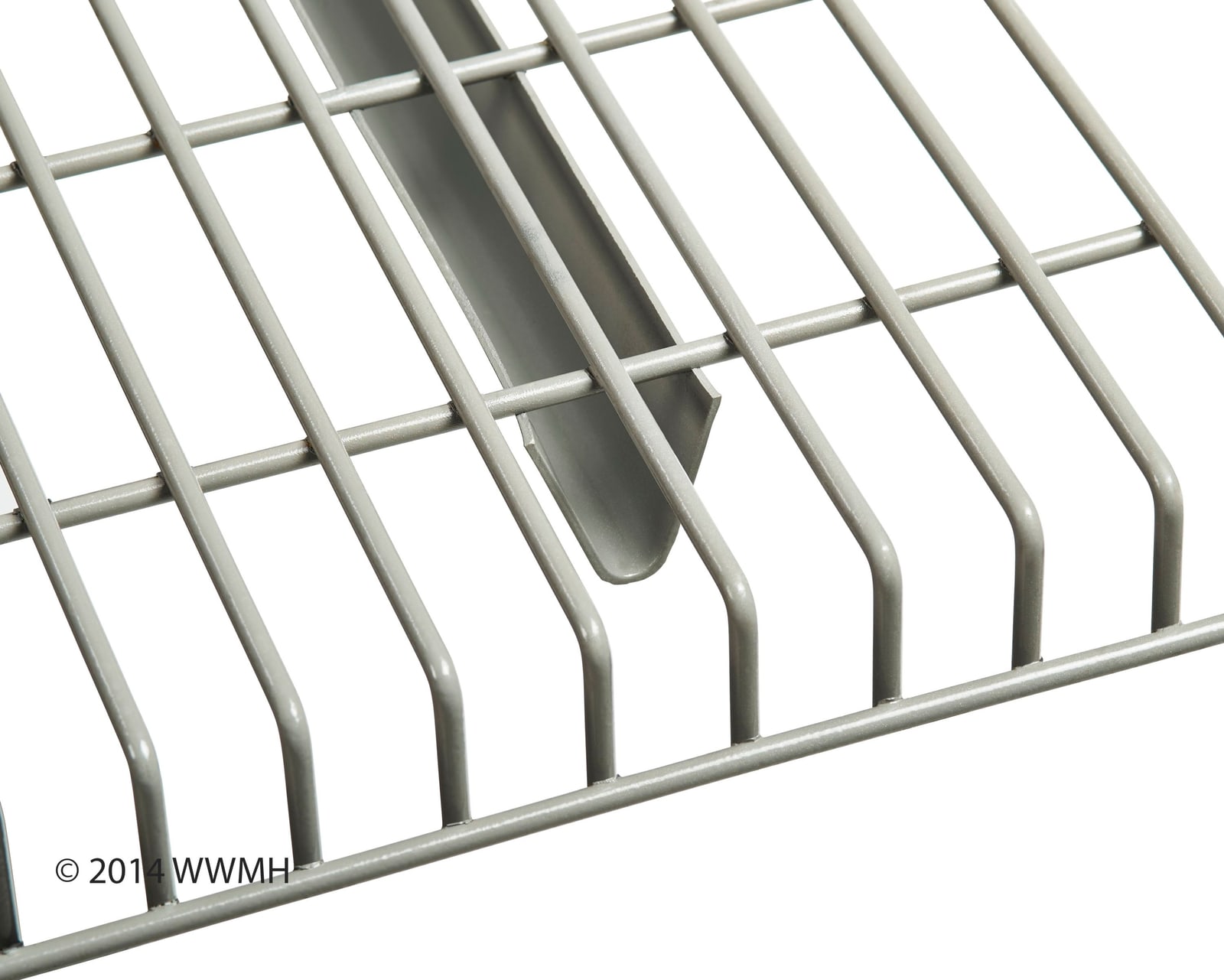
Flared channel, sometimes sold as universal, flares at the channel ends so the deck seats on more than one beam profile. If your facility has been extended over the years and runs mixed beams, which is extremely common, flared channel stops you inventorying two kinds of deck. It's the practical default for mixed estates.
This is the axis that decides whether the deck physically fits. Get it wrong and the deck doesn't seat on the channels the way its rating assumes.
Channel orientation: standard or inverted
On a standard deck the support channel opens upward and forms a trough. Troughs collect dust, product residue, and pests.
Inverted flips the channel to face down, removing the trough and leaving a surface that can be cleaned and inspected. This is standard specification in food, beverage, and pharmaceutical operations and anywhere a sanitation audit applies. It's available on both step and flared channel decks, so choosing it doesn't force a beam-profile compromise.
What Sets Deck Capacity
Three variables, and they compound:
Wire gauge. Heavier gauge wire carries more. This is the number people ask about first and it's only part of the answer. A common industry standard pattern runs 6 gauge wire in a 2-1/2 by 4 inch mesh.
Mesh pattern. The spacing and orientation of the wires changes how load spreads across the panel. A tighter mesh also decides whether small items fall through, which matters as much as capacity if you're storing loose cases.
Support channels. The number of channels under the panel and how deep they are does more for capacity than gauge alone. More channels and deeper channels carry more. Channels are commonly offered in 14 or 16 gauge, and this is the spec most often traded away to hit a price.
The standard behind the numbers
Wire decking is manufactured to ANSI MH26.2, the industry standard covering design, testing, and load rating of welded wire rack decking. It's the reason a published deck rating means something rather than being a marketing figure.
Two practical consequences. Ask whether the deck you're quoted is manufactured to MH26.2, because "rated 2,500 lb" from a supplier who can't answer that is not the same claim. And note that the standard's ratings are based on uniformly distributed load, which is the next section.
Ratings assume the load is spread out
Deck capacities are published as UDL, uniformly distributed load. A concentrated point load, meaning a dense item bearing on a small area of the mesh, is a different case entirely and can exceed what a deck rated well above that weight will take.
Manufacturer order forms typically ask you to declare which you have, separating evenly distributed load from point load and concentrated load. If you're storing anything that bears on a small footprint, say so when specifying. This is the same trap as cantilever arm ratings, which are published the same way.
The rule that actually matters
Deck capacity and beam capacity are separate ratings, and the lower one is your real limit.
This catches people constantly. A level with 5,000 lb beams and decks rated well below that is a level limited by the decks, no matter what the beam capacity plate says. Both numbers have to be confirmed against your heaviest actual load, not an average, and both belong on the load capacity signage for the bay.
Deck capacity, gauge, and channel configuration vary by manufacturer. A specific load rating should always be confirmed against the engineered product data for the exact deck and beam you are buying. Treat any general figure as a starting point rather than a guarantee.
For how the beam side of that equation is derived, see our guide to pallet rack weight capacity.
Fire Code Is Usually the Deciding Factor
This is the part of wire decking that catalog listings skip, and it's the part most likely to cost you money on an inspection.
Sprinkler protection for racked storage depends on water reaching the product inside the rack. Ceiling sprinklers are designed around the assumption that water can get down through the levels. A solid shelf blocks that path. So does a deck packed tightly enough with product, and so does the sheet of plywood someone laid across the mesh because a load kept catching.
The practical consequences:
- Where a sprinkler design assumes open racking, open decking such as wire mesh is generally what it's counting on. Wire deck exists in the form it does largely because of this.
- Substituting solid or obstructed shelving can change the required protection, potentially triggering in-rack sprinklers, which are expensive to add after the building is occupied.
- The change that causes trouble is almost never on the drawings. It's the plywood, the cardboard sheet, or the solid-bottom tote added quietly two years after handover.
Combined with flue space, which is the vertical gap that lets water travel down between and behind loads, decking is part of how the building's fire protection is supposed to function. Our guide to pallet rack spacing requirements covers flue space in detail.
The rule to give your team: any change between open and solid decking goes back to the sprinkler designer and the authority having jurisdiction before it's installed. Not after. We handle exactly this coordination as part of permits and compliance on the systems we install.
Sizing Decks to Your Bay
Deck size follows the bay, not the pallet. You need three things:
- Beam length, which sets how wide the decking has to span.
- Frame depth, which sets deck depth.
- Beam profile, step or box, so the support channels seat correctly.
Most bays run two or three decks side by side across the beam span rather than one continuous panel, which keeps individual decks light enough to handle and lets you replace one without pulling the level apart.
Two practical warnings:
Measure the installed rack, not the original order. Beams get swapped, frames get replaced after damage, and bays get reconfigured. On a system more than a few years old the paperwork and the steel routinely disagree.
Watch pallet overhang. Decking supports overhanging loads, which is one of its main jobs, but the load still has to sit within the rack's engineered footprint. A deck doesn't extend your capacity past what the frames and beams are rated to carry. For how bay dimensions are derived in the first place, see our pallet rack dimensions and sizes guide.
Where Decking Gets Specified Wrong
The failures we see on inspections repeat:
- Gauge chosen, channels ignored. Two decks with the same wire gauge and different channel counts are not the same product, and the cheaper one is usually cheaper for that reason.
- Deck capacity never checked against beam capacity. The level gets loaded to the beam rating.
- Flush decking where waterfall belonged. In a high-traffic aisle with forklift contact, the lip earns its keep.
- Standard channel in a food facility. Passes on day one, fails the sanitation audit.
- Plywood laid over the mesh. Almost always a symptom of the wrong mesh pattern for the product, and a fire protection problem regardless of the reason.
- Mixed beam profiles, single deck type. The deck doesn't seat, so it gets forced, and now it isn't sitting on the channels the way it was rated to.
A Short Specification Checklist
Before you order, have these:
- Beam length, frame depth, and beam profile for every bay type in the run, not just the most common one
- Heaviest actual load per level, not the average
- Whether product is palletized, loose cases, or mixed, which decides mesh pattern
- Whether sanitation requirements apply, which decides channel orientation
- The sprinkler design assumption for the building, which decides whether open decking is mandatory
- The beam capacity for the same level, so you can identify which of the two ratings governs
Getting It Right
Wire decking is cheap relative to the rack it sits in and expensive relative to what it costs to fix after the fact. The two decisions that matter most are the ones least likely to be on a purchase order: whether the deck's own capacity rating clears your heaviest load, and whether anything about your decking choice changes what the building's fire protection is required to do.
We spec decking as part of the engineered system rather than as an accessory line item, confirm capacity ratings against the beams underneath, and coordinate the fire protection question with the AHJ before installation instead of after. Request a consultation to spec decking for your racking, or see our pallet rack accessories guide for how decking fits alongside row spacers, pallet supports, and safety hardware.
Decking is one part of a larger parts list. Our pallet rack components and parts page covers how it fits alongside uprights, beams, anchors, and load signage.
Frequently asked questions
What is wire decking used for on pallet rack?
Wire decking is a welded steel mesh panel that sits across the load beams to create a support surface inside the bay. It carries pallets that overhang their footprint, supports loose cases, cartons, and totes that would otherwise fall through, keeps damaged or odd-sized pallets from dropping between the beams, and lets sprinkler water, light, and air pass through the rack. It is the most common pallet rack accessory because most bays need a load surface and open mesh is the version fire codes accept.
What is the difference between waterfall and flush wire decking?
Waterfall decking wraps the mesh down over the front and rear beams, so the deck hooks over the beam face. That lip resists the deck being knocked up and out of the bay by a fork or a shifting pallet, which is why it is the common default. Flush decking, sometimes called drop-in, sits flat inside the beams with nothing proud of the beam line, creating a level surface from beam to beam. Flush is used where product is picked by hand across the bay or where anything sitting above the beam would catch.
How much weight can wire decking hold?
Wire deck capacity depends on the wire gauge, the mesh pattern, and the number and depth of the support channels underneath, and it is rated by the manufacturer for a specific deck size. There is no single figure that applies across products. What matters more is that the deck carries its own rating, separate from the beams below it, and your real limit for the level is the lower of the two. Confirm both against engineered product data for the exact deck and beam you are buying.
Does wire decking have to be used instead of solid shelves?
Often, yes. Sprinkler design depends on water reaching the product inside the rack, and a solid shelf blocks it. Where ceiling sprinklers are expected to protect racked storage, open decking such as wire mesh is typically what the design assumes, and switching to solid or obstructed shelving can require in-rack sprinklers instead. Any change between open and solid decking should go back to the sprinkler designer and the authority having jurisdiction before it is installed, not after.
What size wire deck do I need for my pallet rack?
Deck size follows the bay, not the pallet. You need the beam length, which sets the deck width, and the frame depth, which sets the deck depth, along with the beam profile, meaning step or box, so the channels seat correctly. Most bays use two or three decks side by side across the beam span rather than one continuous panel. Measure the actual installed rack rather than working from the original order, because beam and frame changes over the years are common.
Why do some wire decks have the channel turned upside down?
That is inverted channel decking, and it is a sanitation feature. On a standard deck the support channel opens upward, which creates a trough where dust, debris, and product residue collect and where pests can shelter. Inverting the channel so it faces down removes the trough and leaves a surface that can be cleaned and inspected. It is common in food, beverage, and pharmaceutical facilities and is often specified where sanitation audits apply.