
Structural Pallet Rack
Structural Pallet Rack: The Heavy Duty Build of Selective Racking
Hot-rolled channel sections bolted at every beam-to-column connection. The build you specify when the aisle gets hit, the room gets cold, or the load runs past what formed steel is rated to carry.
Bolted
Beams bolt to the column, not into a slot
Hot-Rolled
Open C-channel sections rather than formed tube
Seismic Rated
PE-stamped engineered drawings
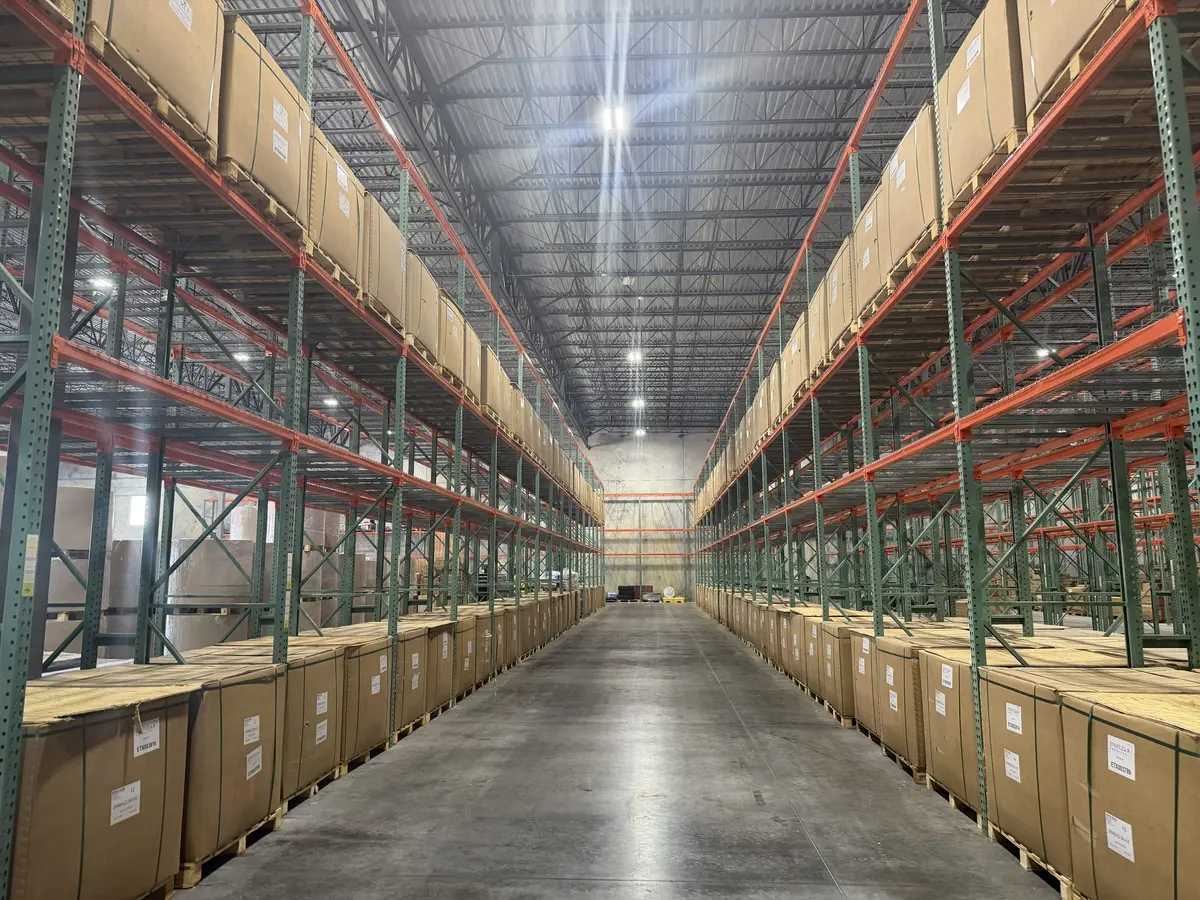
Structural pallet rack is selective pallet racking built from hot-rolled structural steel sections, with beams bolted to the upright columns rather than clipped into punched slots. The beams are open C-channel instead of closed tube. It stores and accesses pallets exactly like any selective system, and it is specified where impact, moisture, or load demands heavier steel.
The Right Application
Where Heavy Duty Pallet Racking Earns the Extra Cost
Freezers, Coolers, and Wash-Down Areas
The open C-profile of a structural beam lets condensation and wash water drain through and dry. A closed roll-formed tube can trap moisture and corrode from the inside, which is the failure mode that does not announce itself because the outside still looks fine. Finish and condensation decisions get made alongside the profile, not after it.
Aisles Where Forklift Contact Is Routine
Not the occasional bump, but contact as a normal part of the day. Grocery and beverage distribution are the usual examples: tight aisles, high throughput, and operators working against a clock. The heavier section absorbs impact that leaves a formed beam bent and a bay out of service. Roll-formed rack is easily damaged in that kind of traffic, and a dented column no longer carries what its load chart says.
Heavy or Concentrated Loads
Loads that sit close to what a beam pair is rated to carry at the span you actually need, or that land on a small footprint rather than spreading across the beam. Capacity is always rated per pair at a specific span, so the question is whether your numbers are tight at your bay width, not whether they are tight in general.
Tall Systems and Rack-Supported Structures
Above roughly 40 feet the rack starts behaving like building structure, sometimes literally in a rack-supported building. Engineered fire suppression and seismic review are mandatory at that height, and the construction type becomes an engineering decision rather than a catalog one.
Buildings That Get Slotted Once and Stay Put
Bolted connections are a cost when beam levels move often and a non-issue when they do not. A facility with a stable product profile gives up very little by choosing the build that does not come apart with a mallet.
Where Structural Is Not the Answer
Ambient distribution at standard pallet weights, in a building that gets re-slotted with the season. That is most of the pallet storage in the country, and [teardrop pallet rack](/solutions/teardrop-pallet-rack) is the better buy for it.
Technical Specifications
Key Specs & Configuration
| What Structural Means | Rack fabricated from hot-rolled structural steel sections, the same family of shapes used in building framing, with the beams bolted to the upright column. The beam is an open C-profile rather than a closed tube. Bolt heads at every beam-to-column connection are the fastest way to recognize it standing in a building. |
| System Type | A construction type, not a separate storage system. Structural rack is selective pallet rack, so selectivity, aisle logic, and rotation all work the way they do on any selective system. |
| Upright Profile | Typically channel or C-sections rather than a punched closed column. Column size, steel thickness, and frame height together set what the frame carries, so the column is specified against the loaded height rather than picked to match a beam. |
| Beam Profile | Structural channel, commonly C3 or C4, meaning 3-inch or 4-inch hot-rolled channel sections with an open C-profile. Structural beams get specified by environment and impact exposure as much as by pure capacity. |
| Frame Depth | 36"–48" standard, sized to your pallet dimensions and load overhang |
| Bay Width and Upright Height | 8'–12' bay widths, 8'–40'+ upright heights, 2–6+ beam levels, specified to your pallet size and ceiling clearance. |
| Beam Capacity | Rated per pair of beams at a specific span, from the manufacturer's load tables for the channel size. Every rating falls as the span gets wider, so capacity is confirmed at your bay width before anything is ordered. Our [pallet rack weight capacity guide](/articles/pallet-rack-weight-capacity) covers how a pair is rated. |
| Aisle Width | Counterbalance forklifts need 12'–13' aisles, reach trucks 8'–10', double-deep reach trucks 9'–12', and turret or VNA trucks 5'–6'. The construction type does not change the aisle; the forklift does. |
| Changing a Beam Level | Unbolt, reposition, re-torque. Slower than a clipped connection by design, which is the trade you accept for the joint. Rated capacity depends on beam spacing, so a re-pitch also means re-rating the bay and updating the load sign. |
| Cold and Wash-Down | The open profile drains and dries rather than holding water inside a section. Finish is specified alongside it, against the temperature zone, the humidity, and how the area is cleaned. |
| Cost Drivers | Steel weight per member, upright height and section size, beam length and rated capacity per pair, total position count, freight on a heavier system, bolted install hours, decking and safety hardware, seismic engineering in your jurisdiction, and whether install happens around live operations. |
| Permits and Seismic | Engineered and PE-stamped for your local seismic zone. Permit requirements are set by storage height and commodity rather than by construction type, and high-piled storage review applies where fire code thresholds are met. Requirements vary by jurisdiction. |
| What We Need to Quote | Pallet dimensions and the heaviest actual load per level, ceiling height and building column spacing, the forklift make and model, the temperature zone and whether the area gets washed down, and an honest account of how often the aisles take contact. |
How It Works
How We Decide a Building Needs Structural Rack
Structural pallet rack is a construction type, not a separate storage system. What it describes is selective pallet racking built from a different family of steel: hot-rolled structural sections rather than sheet formed cold through rollers. Every pallet position still faces an aisle, beam levels still set the bay, and rotation works the way it works on any selective system, so selectivity, aisle logic, and pick-path questions live on the selective page rather than being repeated here. What changes is the steel and the joint. Uprights are typically channel or C-sections. Beams are typically structural channel, commonly C3 or C4, meaning 3-inch or 4-inch hot-rolled channel with an open C-profile instead of a closed tube. And the beams bolt to the column rather than dropping into a punched slot, which is the fastest way to recognize structural rack standing in a building: bolt heads at every beam-to-column connection, and a channel you can see through.
The extra steel pays for itself in specific conditions rather than across the board. Freezers, coolers, and wash-down areas come first. The open profile lets condensation and wash water drain and dry, where the closed tube of a roll-formed beam can trap moisture and corrode from the inside out, and that is the failure mode you do not see coming because the outside still looks fine. Our cold storage page covers the finish and condensation decisions that go with it. Second, aisles where forklift contact is routine rather than occasional, grocery and beverage distribution being the usual examples, because the heavier section absorbs impact that leaves a formed beam bent. Third, very heavy or concentrated loads, where the pair has to carry more at the span you need than a formed section is rated for. Tall systems are worth raising early for a different reason: above roughly 40 feet the rack starts behaving like building structure, sometimes literally in a rack-supported building, and the pallet rack dimensions and sizes guide covers what changes at that height.
What you give up is worth being plain about. Bolted connections do not move with a mallet. Changing a beam level means unbolting, repositioning, and re-torquing, so a building that gets re-slotted several times a year pays for structural twice, once in steel and again in every reconfiguration. The sections are heavier, which shows up as more trucks on the freight line and more hours on install. Hybrid systems come up often enough to mention: structural uprights carrying roll-formed beams, on the logic that the column is what a forklift hits and the beam is what carries the load. They exist, and the connection is the constraint, because a roll-formed beam connector is engineered for a specific punched column. Treat a hybrid as a design question answered on stamped drawings rather than a substitution made in a parts list. For what actually moves the total on either build, our pallet racking cost guide walks through how a racking quote gets built.
What you specify is the same set of numbers every rack project turns on, plus the environment. Pallet dimensions and the heaviest actual load per level, ceiling height and building column spacing, the forklift make and model that will run the aisle, the temperature zone and whether the area gets washed down, and an honest account of how often the aisles take contact. Beam capacity is rated per pair at a span rather than in the abstract, and the pallet rack weight capacity guide covers how that rating is actually built. We design, engineer, permit, and install, and one project manager runs the racking installation from the first site visit through final inspection sign-off, with pallet rack inspections confirming anchors, hardware, and load signage once product is in the bays. If none of the conditions above describe your building, teardrop pallet rack is the lighter, faster, less expensive answer and usually the right one, with rack protection covering the aisles that take the most contact.
What You Get
Built In, Not Bolted On
Bolted Beam-to-Column Connections
Beams bolt to the upright rather than seating in a punched slot. That is what makes the joint stiffer and what makes a re-pitch a wrench job, and both halves of that trade are real.
Specified Against the Environment, Not Just the Load
Temperature zone, humidity, wash-down exposure, and aisle traffic carry as much weight in the decision as pallet weight does. Profile and finish get chosen together, against the room the rack has to live in.
Engineered, Stamped, and Permitted
Systems are engineered and PE-stamped for the local seismic zone, with anchorage, flue spacing, and sprinkler clearance designed in. We handle permitting and inspections, including high-piled storage review where height and commodity trigger it.
Best Suited For
Common Applications and Industries

Cold Storage & Freezers
Freezers, coolers, and blast cells, where condensation and wash-down are constant and a closed section is the thing that corrodes quietly.

Food & Beverage
Heavy palletized product, tight aisles, and high throughput, which is the combination that puts routine forklift contact into the design case.

Manufacturing
Raw material, dies, tooling, and finished goods that run heavy or land on a small footprint rather than spreading across the beam.

Warehouse Distribution
High-traffic distribution aisles and dock-adjacent zones, often specified structural where the contact happens and roll-formed through the rest of the building.
Related Services
We Handle Design, Installation & Permitting
Other Systems to Consider
Related Storage Systems
Teardrop Pallet Rack
The boltless roll-formed alternative. Lighter, faster to install, and far easier to re-pitch, and the right answer for most ambient distribution.
Learn More →Selective Pallet Rack
The system structural rack is a build of. Direct access to every pallet position, adjustable beam levels, and the baseline every other rack type trades against.
Learn More →
Rack Protection
Column guards and end-of-aisle protection, sized to the column profile they wrap and to the forklift fleet that runs the aisle.
Learn More →FAQ
Common Questions
What is structural pallet rack?
Structural pallet rack is selective pallet racking built from hot-rolled structural steel sections, with the beams bolted to the upright columns instead of clipped into punched slots. The beams are open C-channel rather than closed tube, and the uprights are typically channel or C-sections. Because it is a construction type rather than a separate storage system, everything else about it works the way selective pallet racking works: every position faces an aisle, and any pallet can be pulled without moving another.
Is structural pallet rack stronger than roll-formed?
In the same physical footprint, generally yes, and that is the honest way to put it. A structural upright and beam carry more steel, and hot-rolled sections resist impact damage better, so a structural bay at a given depth and height will normally rate higher. That does not make roll-formed rack weak. Heavy duty pallet rack in either build is rated per beam pair at a specific span, and a well-specified roll-formed system carries most distribution loads with room to spare. The useful question is not which is stronger in the abstract, it is whether your loads, your aisles, and your environment call for the extra steel. Our pallet rack weight capacity guide covers how a pair actually gets rated.
When is structural pallet rack worth the extra cost?
Three conditions, and any one of them is usually enough on its own. Freezers, coolers, and wash-down areas, where the open profile drains and dries instead of trapping moisture in a closed tube. Aisles where forklift contact is routine rather than occasional, because the heavier section absorbs hits that bend formed steel. And very heavy or concentrated loads that sit close to what a beam pair is rated to carry at the span you need. Tall systems are a fourth case, since above roughly 40 feet the rack behaves like building structure. Outside those, roll-formed teardrop is usually the better buy, and the money saved goes further in rack protection, decking, and a real inspection program. Our structural vs. roll-formed comparison works through the decision in order.
Is structural rack better for cold storage and freezers?
Usually, and the reason is drainage rather than strength. A structural beam has an open C-profile, so condensation and wash-down water run out and the section dries. The closed tube of a roll-formed beam can hold moisture inside and corrode from the inside out, which is the failure mode you do not see coming because the exterior still looks fine. Roll-formed rack still fits many cooler applications, particularly with a galvanized finish, so the decision is made against the temperature zone, the humidity, how the area is cleaned, and how hard the aisles get driven. Our cold storage page covers the finish and condensation side of it.
Can structural pallet rack be reconfigured?
Yes, but not quickly, and that is the main thing you trade away. Beam levels are bolted, so moving one means unbolting, repositioning, and re-torquing rather than tapping a connector out with a mallet. Bays can still be added, removed, or relocated, and a system can be dismantled and reinstalled elsewhere. Rated capacity depends on beam spacing, so any re-pitch also means re-rating the bay and updating the load sign. If your building gets re-slotted several times a year, that reconfiguration cost is worth pricing before you choose the build.
What drives the cost of structural pallet rack?
Steel weight does most of it. Structural sections use more steel per member and hot-rolled stock costs more per pound than sheet, so upright height, section size, beam length and rated capacity per pair, and total position count set the bulk of the number. After that: freight, since a heavier system is more trucks; install hours, since bolted connections take longer than clipped ones; decking and safety hardware; seismic engineering and permitting in your jurisdiction; and whether installation works around live operations. What belongs on the other side of the ledger is what the system avoids, because in a freezer or a high-impact aisle the repair and replacement cycle is the real comparison. Our pallet racking cost guide walks through how a racking quote is built. Send us your details through contact and we will scope it.
Get a Quote
Get a Quote on Structural Pallet Rack
Tell us your building and storage goals. We come back within one business day with a layout concept and a budget number, design, permits, and installation included.
- Free site assessment and layout
- Permits and PE-stamped drawings included
- Vetted, insured installation crews
Request a Free Quote
One business day response. No obligation.
Not Sure Your Building Needs Structural Rack?
Send us your pallet weights, bay dimensions, temperature zone, and an honest account of how your aisles get driven, and we will tell you which build fits. Free consultation, no obligation.
Schedule a Free Consultation