

Narrow Aisle & VNA Racking
Narrow Aisle & VNA Racking: More Positions, Every Pallet Still Accessible
The one density lever that keeps 100% selectivity. Same selective frames and beams, narrower aisles, and a layout built around the truck that will serve them.
60,000 Positions
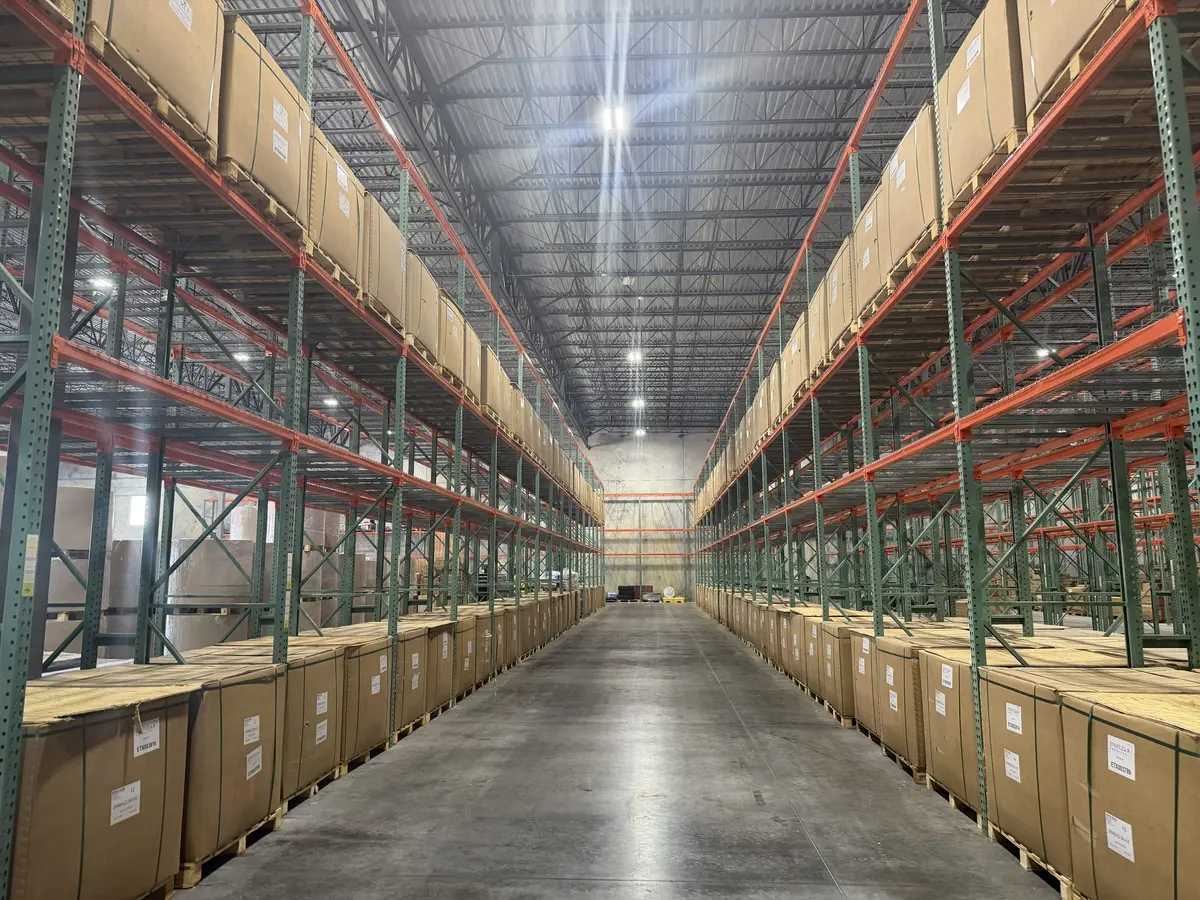
VNA install at our Victorville, CA campus project
30 to 50%
More positions than wide-aisle selective
80 in Aisles
Wire-guided, on our three VNA projects
Narrow aisle racking is standard selective pallet rack laid out with aisles sized for narrow-aisle lift trucks instead of counterbalance forklifts. Reach trucks work in 8 to 10 ft aisles; very narrow aisle (VNA) layouts use turret trucks in aisles of 5 to 7 ft. The rack itself does not change: every pallet position still faces an aisle, so selectivity stays at 100%.
The Right Application
Where Narrow Aisle Racking Earns Its Keep
Too Many SKUs for Deep Lanes
Deep-lane systems only pay when a product fills a whole lane. If you rarely hold more than 8 to 10 pallets of one SKU at a time, deep lanes create rehandling. Narrowing the aisle adds positions without asking any lane to hold one product.
Lot Control and FIFO Picking
Every position is independently addressable, so first-in, first-out, lot-specific and date-sensitive picking all still work. Nothing is trapped behind another pallet.
Clear Height You Are Not Using
Turret trucks lift into the 30 to 40 ft range and beyond, where counterbalance equipment cannot operate. A VNA conversion often gains beam levels as well as rows.
Expensive or Conditioned Space
When the cost of the building is the constraint, adding positions inside walls you already pay for, and already cool, usually beats adding walls.
A Full Building With a Mixed Product Profile
The building is out of room, but the inventory is too varied for push back or drive-in. Narrowing the aisles is usually the first density lever to pull in that situation.

Technical Specifications
Key Specs & Configuration
| Rack Type | Standard selective pallet rack. Narrow aisle is a layout of selective rack, not a different structure, so frames, beams and decking are the same components. |
| Operating Aisle Width | Counterbalance forklift 12 to 13 ft; reach truck 8 to 10 ft; swing-mast and articulated trucks 6 to 7 ft; turret truck (true VNA) 5 to 7 ft. Verify with your forklift manufacturer for the model you run. |
| Selectivity | 100%. Every pallet position faces an aisle. |
| Inventory Method | FIFO, LIFO or lot-based, because every position is independently addressable |
| Upright Height | Specified to your ceiling and sprinkler clearance. VNA frames commonly run 30 to 40 ft or taller. |
| Truck Guidance | True VNA aisles leave inches of clearance, so turret trucks typically run in guided aisles, wire or rail, rather than free-steering. Guidance is part of the installation scope. |
| Floor Requirements | Tall masts in tight aisles magnify slab imperfections. Floor condition is evaluated during layout design, and older slabs sometimes need remediation in the aisle lanes. |
| Fire Code Notes | Storage over 12 ft triggers a high-pile fire code review, and 30 to 40 ft frames often require ESFR or in-rack sprinklers, depending on commodity and jurisdiction. Sprinklers require a minimum 18 in clearance above the top of stored product. Requirements vary by jurisdiction. |
| Seismic Rating | Engineered and PE-stamped for your local seismic zone, designed in from the start rather than added after installation |
| What We Need to Quote | Pallet dimensions and heaviest actual load, SKU count and pallets held per SKU, clear height and column spacing, slab condition if known, and the make and model of the truck you run or plan to buy. |
How It Works
How We Design a Narrow Aisle Racking System
Narrow aisle is not a different rack. It is selective pallet racking laid out with narrower aisles, built on the same upright frames and beams. Every other way to store more pallets per square foot, double deep, push back or drive-in, trades away access to some positions. A narrow aisle layout keeps every position facing an aisle and takes the space out of the aisles instead, typically adding 30 to 50% more pallet positions than wide-aisle selective in the same building.
So the first decision is the truck, not the rack. The truck sets the aisle and the aisle sets everything downstream: how many rows fit, how high the frames go, and how many positions the layout finishes with. Reach trucks work in 8 to 10 ft aisles. Turret trucks work true VNA aisles of 5 to 7 ft and lift into the 30 to 40 ft range, so a VNA layout gains height as well as rows. Our guide to VNA aisle widths and narrow aisle trucks walks through the equipment in detail, and the aisle number is always confirmed with your forklift manufacturer before anything gets drawn.
Then the building has to support the truck. VNA aisles leave inches of clearance, so turret trucks typically run on wire or rail guidance, and tall masts in tight aisles magnify every slab imperfection. We evaluate floor condition during layout design, and guidance is part of the installation scope rather than an afterthought. At VNA heights the code review grows too: storage over 12 ft triggers high-pile review, 30 to 40 ft frames often require ESFR or in-rack sprinklers depending on commodity, and permits vary by jurisdiction. Every system is engineered and PE-stamped for the local seismic zone, and we handle permitting and compliance.
We assess the facility before we quote, on-site or from floor plans and photos depending on project scope. Our VNA work includes a 500,000 sq ft document storage campus in Victorville, CA, at roughly 60,000 pallet positions six levels high on 80 inch wire-guided aisles, and a retrofit that added VNA racking to an in-service building in Carrollton, TX. Our own crews handle the racking installation, and pallet rack inspections keep the system in spec once it is loaded. To see what narrower aisles do to your pallet count before talking to anyone, run your building through our free capacity calculator.

What You Get
Built In, Not Bolted On
Laid Out Around Your Truck
The aisle comes off the equipment you will actually run, confirmed against the manufacturer's specification, not off a generic table.
Engineered, Stamped, and Permitted
Systems are engineered and PE-stamped for the local seismic zone, with flue spacing and sprinkler clearance designed in. We handle permitting, including high-pile review where storage height triggers it.
Floor and Guidance in Scope
Slab condition is evaluated during layout design, and wire or rail guidance for VNA aisles is part of the installation scope.

Best Suited For
Common Applications and Industries

Warehouse Distribution
High SKU counts in a full building, where density has to come from the aisles because deep lanes would bury product.

Third-Party Logistics
Many clients and many SKUs under one roof, each needing direct access to every pallet.

Cold & Freezer Storage
Conditioned space where every square foot carries a premium and lot rotation still matters.

Records & Archive Storage
Tens of thousands of boxes where any one can be requested, the work behind all three of our VNA projects.
Related Services
We Handle Design, Installation & Permitting
Our Work
Projects Using This System
View All Projects →Haslet, TX · 58,266 pallet positions · 6 levels high
Phased VNA Racking for Document Storage Facility
View Project →

Victorville, CA · 500,000 sq ft · 60,000 pallet positions
High-Volume VNA Racking for Document Storage Campus
View Project →

Carrollton, TX · 2,000 pallet positions · 5 levels high
Very Narrow Aisle Racking Retrofit for Document Storage
View Project →
Other Systems to Consider
Related Storage Systems
Selective Pallet Rack
The base system, and the same frames and beams, laid out at a standard forklift aisle.
Learn More →
Double Deep Pallet Racking
Two pallets front to back per aisle face. More density, at the cost of access to the rear position.
Learn More →
Mobile Pallet Racking
Rows on motorized carriages that open one aisle at a time, removing almost every fixed aisle from the floor.
Learn More →FAQ
Common Questions
What is narrow aisle racking?
Narrow aisle racking is standard selective pallet racking laid out with aisles sized for narrow-aisle lift trucks instead of counterbalance forklifts. Reach trucks work in 8 to 10 ft aisles, and very narrow aisle (VNA) layouts use turret trucks in 5 to 7 ft aisles. The rack is unchanged, so every pallet position still faces an aisle.
What is the difference between narrow aisle and VNA racking?
The aisle width and the truck. Narrow aisle usually means reach-truck aisles of 8 to 10 ft. Very narrow aisle (VNA) means turret-truck aisles of 5 to 7 ft, typically with wire or rail guidance and taller frames, often 30 to 40 ft or more. VNA goes denser, and it asks more of the floor, the equipment budget and the fire code review.
How much more storage does narrow aisle racking add?
Narrow aisle layouts typically add 30 to 50% more pallet positions than wide-aisle selective in the same building, while keeping direct access to every pallet. The real number depends on your truck, clear height and column spacing, so we size it against your floor plan. Our capacity calculator shows the effect of different aisle widths on your own dimensions.
Is narrow aisle better than push back or drive-in?
They solve different problems. Narrow aisle keeps 100% selectivity, so it fits high-SKU-count operations. Push back and drive-in store deeper per lane and can go denser, but only when whole lanes hold one product. If you rarely hold more than 8 to 10 pallets of one SKU at a time, narrow aisle is usually the density lever to pull first.
Does VNA racking need a special floor?
Often, yes. Turret trucks are less tolerant of uneven slabs than standard forklifts, because a tall mast in a tight aisle magnifies every imperfection. We evaluate slab condition during layout design, and older floors sometimes need remediation in the aisle lanes before a VNA system goes in.
What does narrow aisle racking cost?
The rack is standard selective, so the steel is priced like any selective system of the same height and load rating. What moves the number is everything around it: the narrow-aisle trucks, which are often the largest line item, guidance for VNA aisles, any slab remediation, and sprinkler work at taller heights. Our pallet racking cost guide shows how a racking quote is built. Send us your details through contact and we will scope it.
Get a Quote
Get a Quote on Narrow Aisle & VNA Racking
Tell us your building and storage goals. We come back within one business day with a layout concept and a budget number, design, permits, and installation included.
- Free site assessment and layout
- Permits and PE-stamped drawings included
- Vetted, insured installation crews
Request a Free Quote
One business day response. No obligation.
Out of Floor Space but Need Every Pallet?
Send us your clear height, your SKU profile and the truck you run, and we will tell you how far narrower aisles can take your building. Free consultation, no obligation.
Schedule a Free Consultation